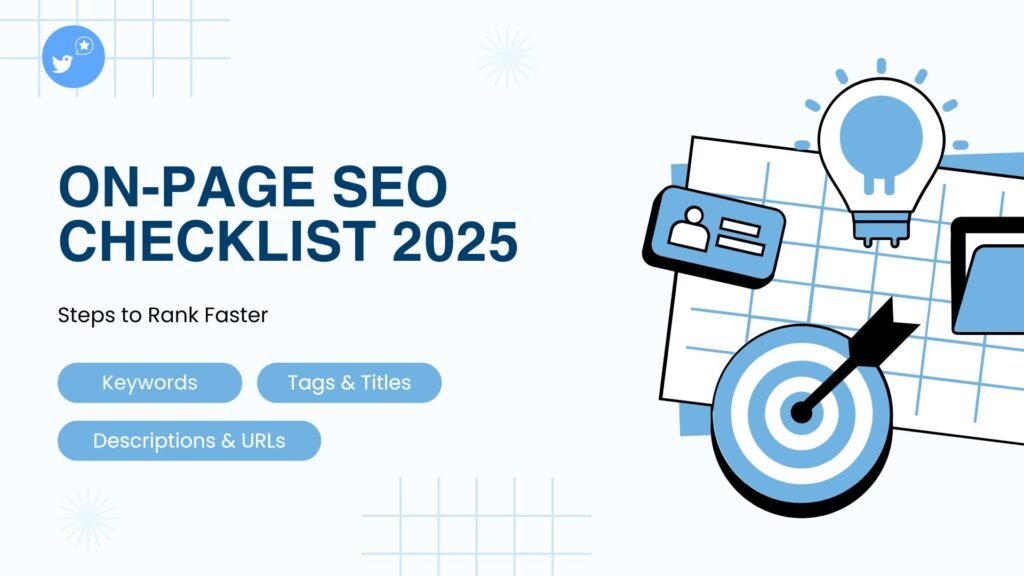
Search engine optimization (SEO) is constantly evolving, and staying ahead of Google’s algorithm updates is crucial for ranking faster. While backlinks, content marketing, and technical SEO remain important, on-page SEO continues to be the foundation for organic growth.
In this guide, we’ll cover a comprehensive On Page SEO Checklist for 2025—practical steps, strategies, and trends you can apply right now to improve visibility and drive qualified traffic.
1. Optimize Title Tags for CTR & Keywords
- Keep titles within 50–60 characters.
- Place the primary keyword closer to the beginning.
- Use power words (e.g., “Proven,” “Ultimate,” “Checklist”) to improve click-through rate.
- Match search intent—if the query is informational, don’t use overly salesy headlines.
✅ Example: On-Page SEO Checklist 2025: Proven Steps to Rank Faster
2. Craft Compelling Meta Descriptions
- Stay within 150–160 characters.
- Summarize content with primary + secondary keywords naturally.
- Add a CTA (Call-to-Action) like “Learn more,” “Discover strategies,” or “Get started today.”
- Make each page description unique.
3. Focus on Content Depth & Topical Authority
Google’s Helpful Content Update emphasizes user-first content. In 2025, thin content won’t survive.
- Cover the topic in depth, not just surface-level.
- Include related subtopics and semantic keywords.
- Use FAQs and examples to make the page more resourceful.
- Add recent stats, tools, and case studies.
4. Use Keywords the Smart Way
Keyword stuffing is outdated. Instead:
- Maintain a natural keyword density (around 1–2%).
- Use LSI (Latent Semantic Indexing) keywords for context.
- Optimize for voice search queries (long-tail, conversational phrases).
- Place keywords in titles, headers, intro, conclusion, alt text, and internal links.
5. Structure with Header Tags (H1, H2, H3)
- Each page should have one H1 tag only.
- Use H2/H3s for subtopics and questions.
- Optimize headers with secondary keywords.
- Make headers scannable—users should grasp the flow quickly.
6. Improve Internal Linking Strategy
- Add 3–5 internal links per blog.
- Link to relevant and authoritative pages within your site.
- Use descriptive anchor text instead of generic “click here.”
- Maintain a logical content hierarchy with pillar and cluster pages.
7. Optimize Images & Media
Images are powerful, but they can slow down websites if not optimized.
- Use descriptive alt text with keywords.
- Compress images with tools like TinyPNG or WebP format.
- Add captions when relevant.
- Use original graphics, infographics, or charts to improve engagement.
8. Mobile-First & Core Web Vitals
Google indexes mobile versions first. In 2025, performance is critical:
- Ensure responsive design across devices.
- Optimize for Core Web Vitals (LCP, FID, CLS).
- Reduce page load time (under 2.5 seconds).
- Avoid intrusive pop-ups on mobile.
9. Optimize URL Structure
- Keep URLs short, clean, and keyword-rich.
- Avoid unnecessary numbers, parameters, or stop words.
- Use hyphens (-) instead of underscores.
✅ Example:
❌ yoursite.com/blog?id=123
✔ yoursite.com/on-page-seo-checklist-2025
10. Add Schema Markup (Structured Data)
Schema helps search engines understand your content better.
- Use FAQ schema for question-based queries.
- Apply Article schema for blogs.
- Add Review schema if applicable.
- Check implementation with Google’s Rich Results Test.
11. Enhance User Engagement Signals
Google rewards content that keeps users engaged.
- Use bullet points, short paragraphs, and visuals.
- Add jump links (Table of Contents) for easy navigation.
- Include videos or podcasts for higher dwell time.
- Encourage comments and shares.
12. Security & Accessibility
- Ensure HTTPS is enabled.
- Make the site accessible (alt text, ARIA labels).
- Avoid broken links and fix redirects.
13. Regularly Update Content
Content freshness is a ranking factor.
- Update old blogs with new stats and trends.
- Re-optimize for current keywords.
- Repurpose content into infographics, carousels, and videos.
Bonus: AI & SEO in 2025–26
With AI-powered search like Google SGE (Search Generative Experience) on the rise:
- Optimize content for AI-generated answers.
- Use conversational and contextual keywords.
- Create authoritative, trustworthy content (E-E-A-T: Experience, Expertise, Authoritativeness, Trustworthiness).
The SEO landscape in 2025–26 demands a user-first, mobile-friendly, and AI-ready approach. By following this On Page SEO Checklist 2025, you’ll build stronger authority, improve rankings, and deliver a seamless experience that keeps users engaged.
Remember: On page SEO isn’t just about keywords—it’s about making your content useful, accessible, and valuable for your audience.