Claude Fable 5 Unavailable
Anthropic has temporarily suspended Claude Fable 5 following reported U.S. government concerns around advanced AI capabilities.
Read Article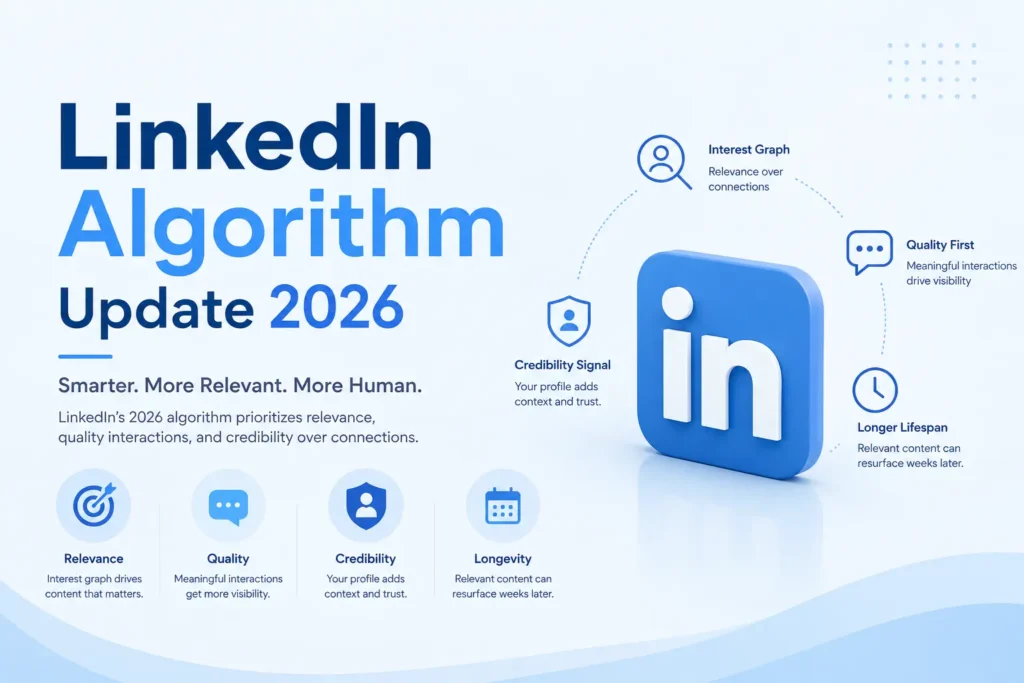
If your LinkedIn reach has quietly collapsed this year, you're not imagining it. LinkedIn rebuilt the core system that decides who sees your posts, and it's arguably the biggest change to the platform's feed since it launched. But a lot of what's circulating about why your posts are underperforming mixes confirmed facts with practitioner guesswork — so here's what's actually changed, sourced back to LinkedIn's own engineering announcement where possible.
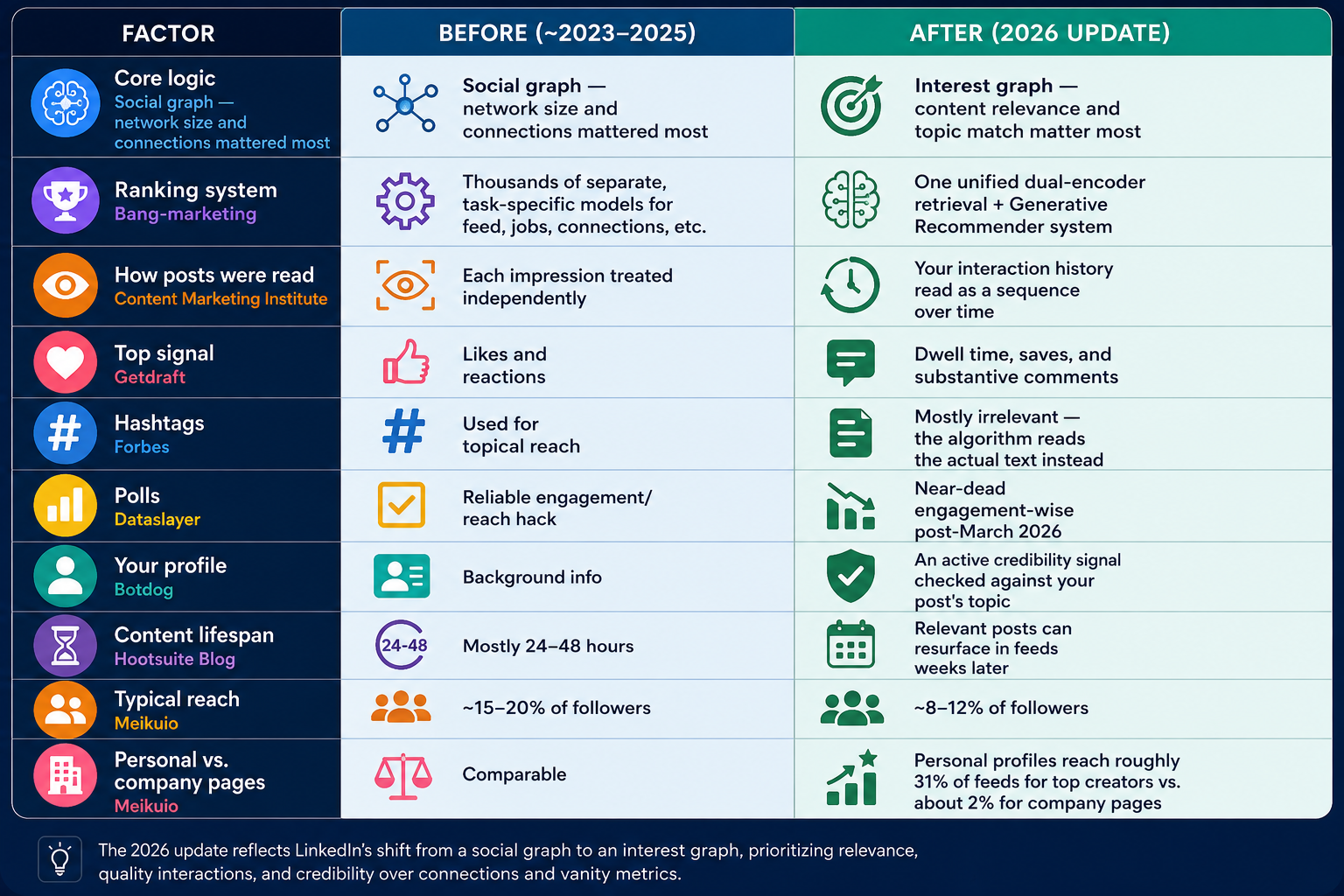
In March 2026, LinkedIn rebuilt its Feed recommendation system, replacing a fragmented, multi-pipeline architecture with a unified LLM-based system: a dual encoder for retrieval and a transformer-based Generative Recommender model for ranking. In practice, that means:
The "LinkedIn algorithm" isn't one thing — it's the recommendation system that decides which posts show up in your feed, in what order, and how far each post travels beyond your immediate network. It's less a single ranked list and more a matching engine: it's constantly trying to pair content with the members most likely to find it useful.
The confirmed part of the story starts with a technical blog post. On March 12, 2026, LinkedIn Senior Staff engineer Hristo Danchev published the most detailed account the company has ever given of how its feed works, in a post titled "Engineering the next generation of LinkedIn's Feed." According to that post, the system now works in two layers: a retrieval stage that reads the meaning of your profile and history to assemble a shortlist of relevant posts, followed by a ranking stage — the Generative Recommender — that orders them.
That second layer is a meaningful departure from how ranking used to work. Danchev explained that the old system evaluated each post in isolation and missed the sequential patterns in how people actually consume content over time. The new model instead processes over a thousand of a member's past interactions as a sequence — a running narrative of their professional interests — rather than a snapshot of their last few clicks. It also learns from silence: posts that were shown to someone but got zero engagement are logged as "hard negatives," training data that actively teaches the model what not to surface again.
You've probably seen the name "360Brew" attached to every article about this update, so it's worth being precise here. 360Brew is a real, 150-billion-parameter decoder-only foundation model that LinkedIn's research team detailed in a January 2025 paper. But that paper was later withdrawn from public hosting over a licensing issue, and LinkedIn has never published anything confirming that the specific 360Brew model is what runs the production feed. What LinkedIn has officially confirmed is the dual-encoder-plus-Generative-Recommender system described above. "360Brew" has effectively become industry shorthand for the whole overhaul, whether or not that exact model is doing the ranking — worth knowing before you take any "360Brew ranking formula" article too literally
Around the same time, LinkedIn tightened enforcement against manipulation tactics. Practitioners have dubbed this the "Authenticity Update" — a crackdown that officially killed classic engagement-bait phrasing, legacy engagement pods, and automation tools. External link spam got hit too, and polls — once a reliable engagement booster — reportedly dropped to a negligible 0.07% engagement rate in post-update analyses.
If you also run LinkedIn ads, note that LinkedIn's April 2026 update introduced stricter sponsored-content disclosure requirements alongside the organic ranking changes, including tighter rules for qualifying content as a "Thought Leader Ad." Worth a separate audit if paid content is part of your mix.
Dwell time. This is the metric everyone agrees moved to the center of the system. Posts that hold attention for over 61 seconds have been observed at roughly a 15.6% engagement rate, compared to about 1.2% for posts people skim in under 3 seconds. Practically: hook readers in the first two lines so they click "see more," and write in short, scannable chunks so they keep reading.
Saves. A bookmark is one of the strongest "this was valuable" signals a person can send. One analysis of over 3 million posts found a save drives roughly 5x more reach than a like, and about 2x more than a comment. The same analysis found posts that pick up saves and substantive comments 24–72 hours after publishing tend to perform 4–6x better — a sign the system now rewards lasting value, not just a fast first hour.
Comment quality (not just count). Estimates of exactly how much more comments outweigh likes vary by source — anywhere from roughly 2x for a typical comment up to around 15x for a substantive comment of 15+ words. What's consistent across sources is the direction: a short "great post!" barely counts, while a comment that adds a real perspective and sparks a reply thread does a lot of algorithmic work.
The "golden hour." LinkedIn tests a new post with roughly 2–5% of your network first, typically over the first 60–90 minutes, before deciding whether to expand distribution. Being available to reply quickly during that window still matters.
Profile-topic alignment. Your headline, About section, and experience now function as a credibility check the algorithm runs before distributing your posts. Post consistently outside your stated expertise, and distribution drops — the system is effectively asking "does this person actually know this topic?"
The bottom line: LinkedIn didn't just tweak a ranking formula — it rebuilt the engine and changed what "good content" means to the system. Relevance and attention now beat volume and network size. Adjust your format mix, tighten your topic focus, and show up for the conversation, and the update works in your favor.
Anthropic has temporarily suspended Claude Fable 5 following reported U.S. government concerns around advanced AI capabilities.
Read Article
A realistic approach to measuring content marketing ROI beyond pageviews — leads, assisted conversions, and value.
Read Article